Tenerife guide
How to go stargazing in Tenerife
Almost everyone knows the sky is good here. Far fewer know when it is worth looking, what to expect to see, and how to prepare so you do not spend two cold hours thinking about the car. That is what this piece is for.
I write from the work: I am a Starlight Guide, and a good share of my working nights are spent observing the sky with travellers who have never looked through a telescope.
Why the sky is so good here
It is not marketing. It is geography and legislation.
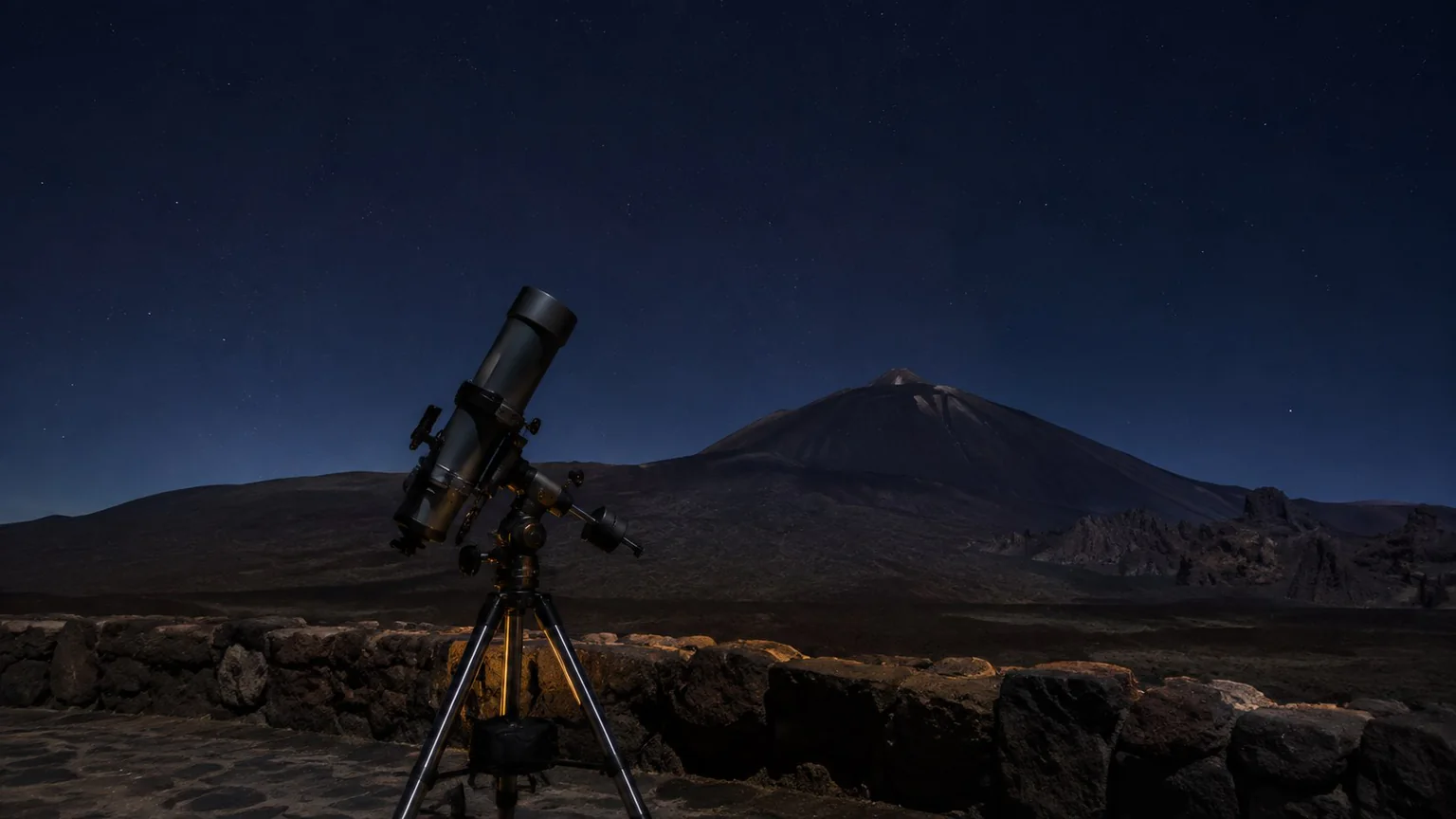
Altitude. Above 2,000 metres you have left behind much of the moisture and particulate matter that muddies the atmosphere. There is less air overhead and the image is steadier.
The cloud layer. The trade winds form a band of cloud on the northern slope at mid-altitude. From above, that layer acts as a lid: it holds the moisture down and, incidentally, blocks much of the coastal light pollution.
Atmospheric stability. The islands’ position in the Atlantic and the prevailing wind regime produce nights with relatively low atmospheric turbulence, which is what determines how sharp things look through a telescope.
Legal protection. Since 1988 the Canary Islands have had specific legislation protecting the astronomical quality of the sky above the observatories of the Instituto de Astrofísica de Canarias, regulating lighting, emissions and flight paths. One of those observatories sits at Izaña, on this island. Professional astronomy did not choose this place by accident.
When to come: the Moon matters most
If you can choose your date, this is the decision that shapes the night more than any other.
A full Moon floods the sky and washes out faint stars, the Milky Way and much of the deep sky. In exchange, the Moon itself is a remarkable object through a telescope and the night landscape is lit, which has its own appeal.
A new Moon or a quarter leaves far more sky available: clusters, nebulae, galaxies and the Milky Way in season.
Neither option is "bad". They are different experiences. If you are coming for the Milky Way, avoid the full Moon. If you are coming with small children who are wowed by craters, the Moon is unbeatable.
What is visible through the year
The sky turns over the course of the year, so what is available changes by month:
- Winter. Orion season, and the most recognisable northern constellations. Long nights, often very transparent. Also by far the coldest.
- Spring. A good time for galaxies, which cluster in this part of the sky.
- Summer. The Milky Way shows its densest stretch, with the galactic centre high above the horizon. Short, mild nights and a very busy island.
- Autumn. Usually good stability and fewer visitors.
On top of that come the planets, which depend on the year rather than the season, and the meteor showers, which have fixed dates but variable results depending on the Moon.
If your dates are flexible, write to me with your range and I will tell you which night suits best.
How the weather affects it
Honesty is compulsory here: nobody can guarantee a clear sky. What you can do is read the forecast properly.
Before a session I look at high cloud, wind at the summit, calima — suspended dust that badly reduces transparency — and humidity. A night with low cloud on the coast can be perfect up top; a night that looks clear from below can be useless up there if there is high veil.
Which is why you should be sceptical of anyone promising guaranteed observing.
What to bring
- Far more clothing than you think. At night, at that altitude, it is cold even in July, and you are standing still. Layers, windproof jacket, long trousers.
- Hat and gloves from October to May, without hesitation.
- Closed shoes. You will be standing on uneven ground.
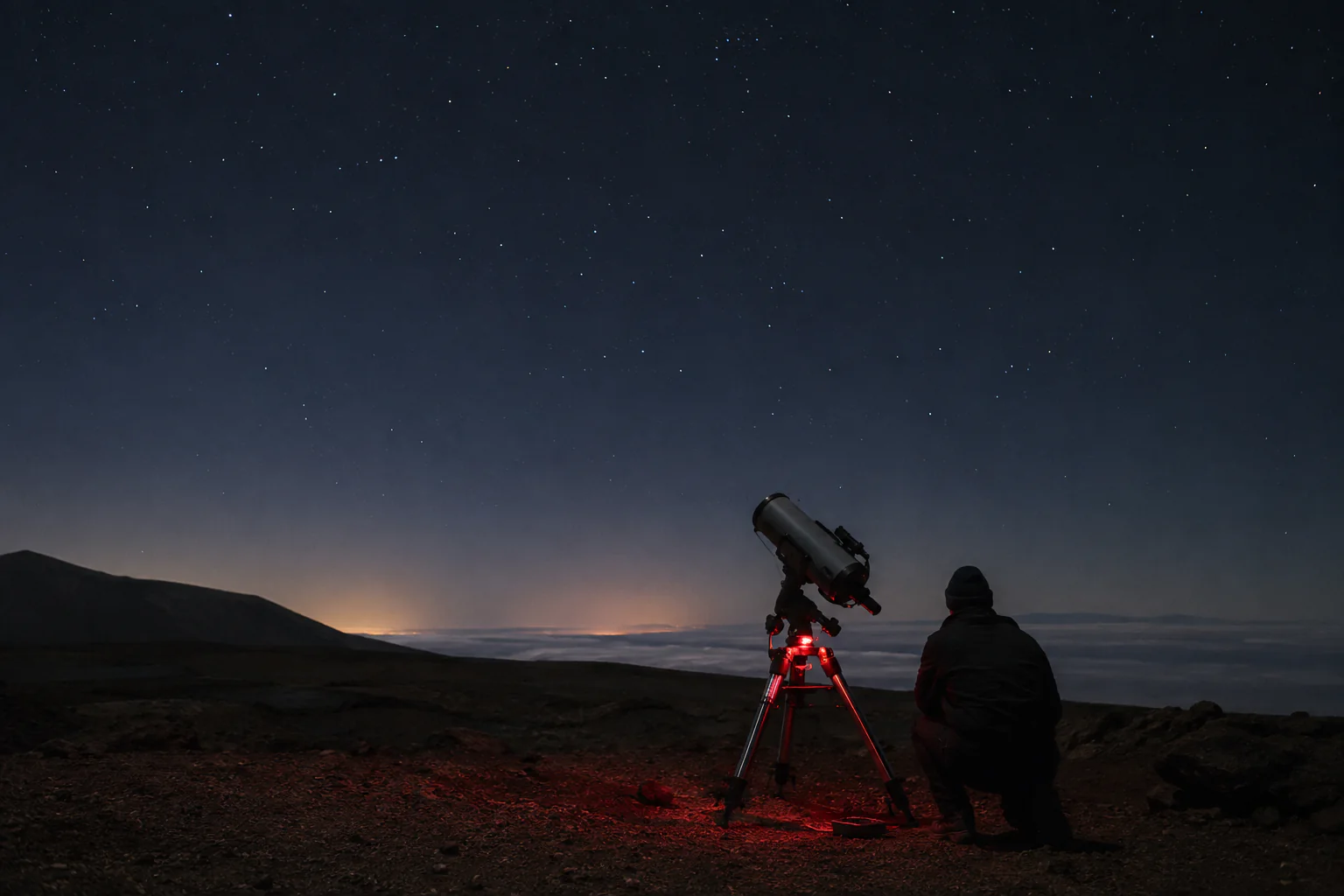
- A red torch, if you have one. White light destroys the whole group’s dark adaptation for several minutes.
- Your phone in night mode, brightness at minimum, no flash.
- Something to eat and drink, if you are going independently.
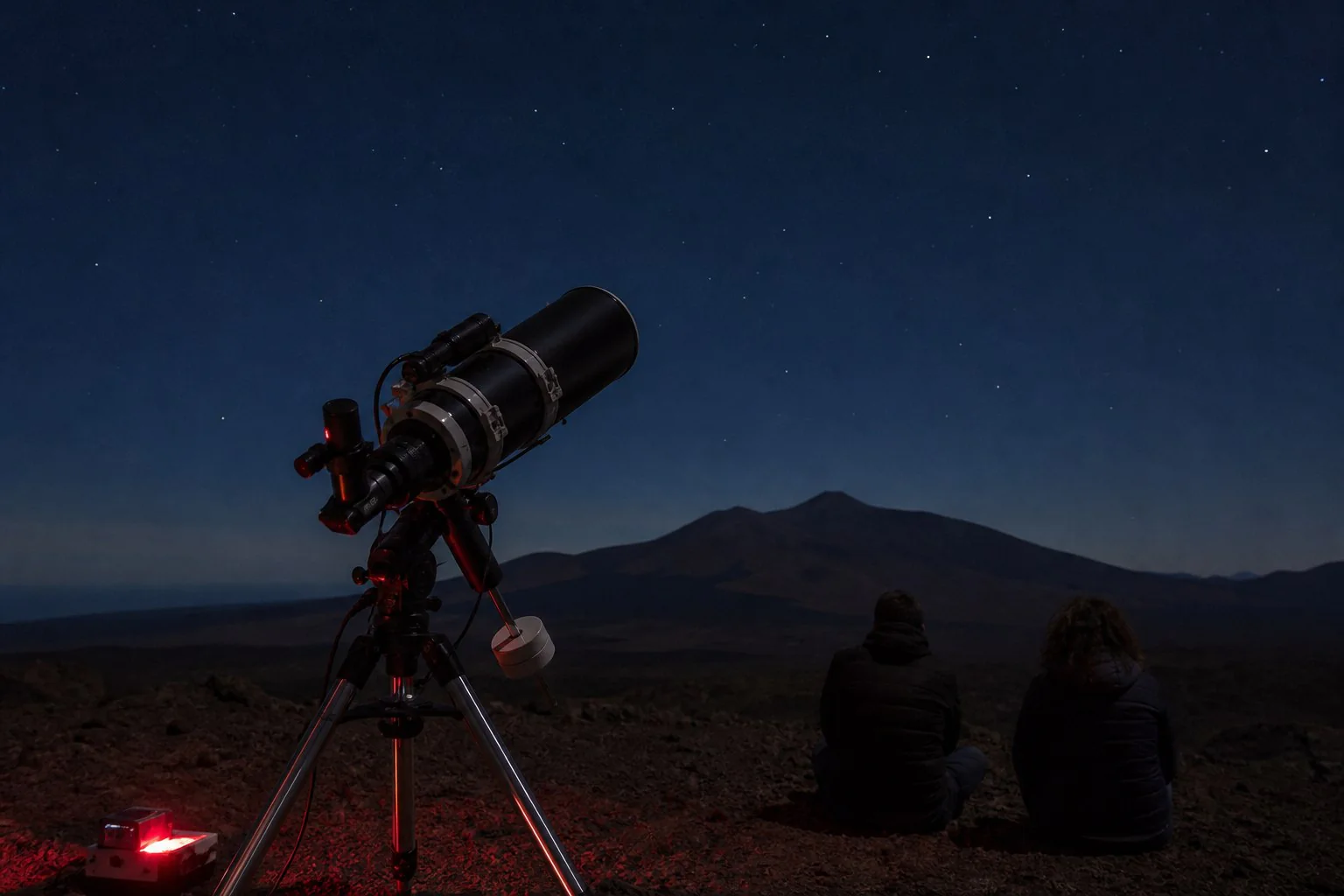
One detail that surprises people: the eye takes twenty to thirty minutes to fully adapt to darkness. That is why a night of observing does not start at the telescope.
What to expect from a night of observing
If it is your first time, adjust your expectations in two directions.
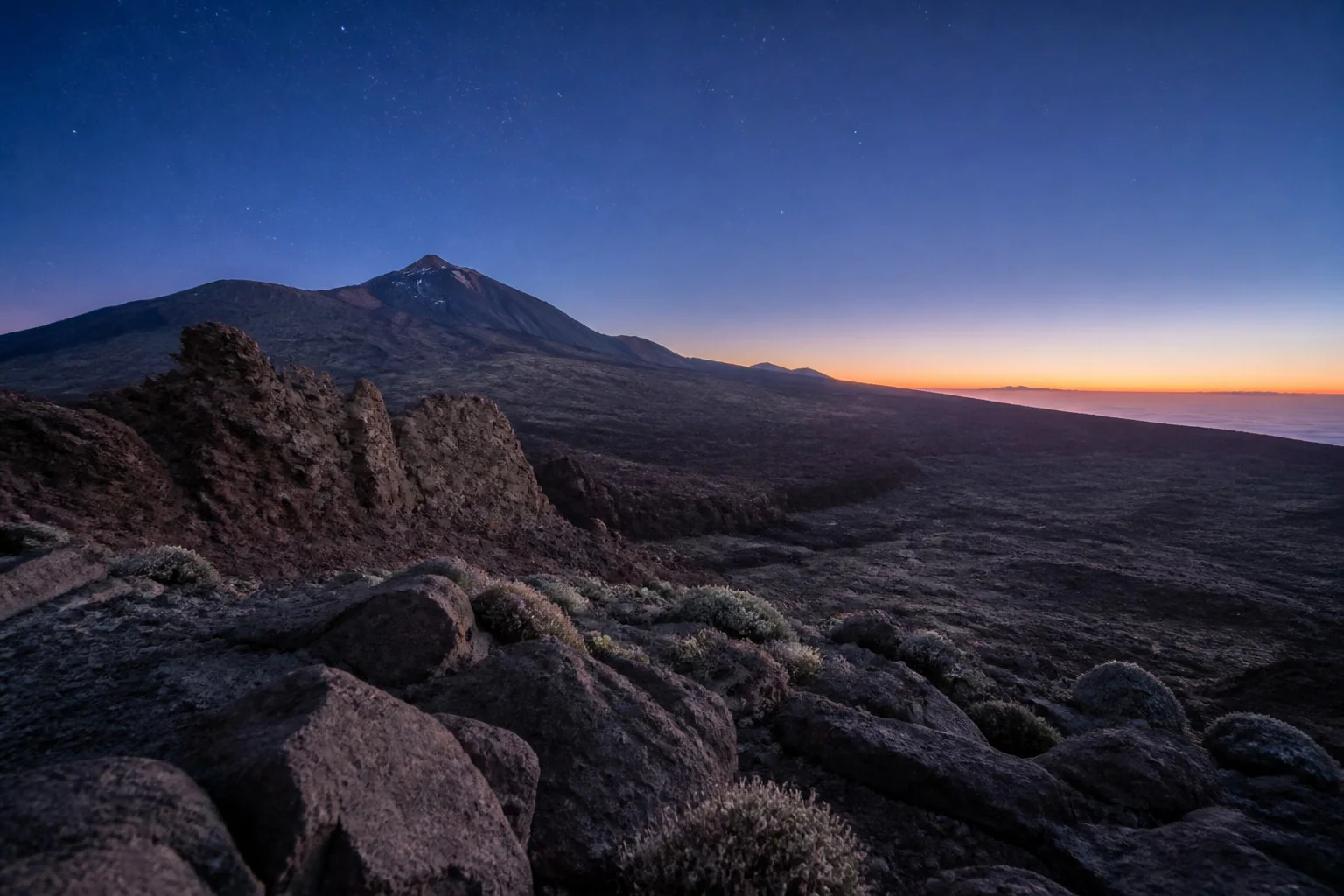
Downwards: an amateur telescope does not show the saturated colour images you see in photographs. Those are long-exposure composites. What you see is subtler and mostly grey, with exceptions like the Moon, Saturn and Jupiter, which impress immediately.
Upwards: seeing Saturn’s rings with your own eyes, live, is nothing like seeing it on a screen. And recognising a constellation unaided for the first time, or understanding why that star sits exactly there, is what people remember months later.
A good session is not about collecting objects. It is about looking at a few things and understanding them.
Independently or with a guide
Independently works perfectly well. Drive up to somewhere high and away from lights, let your eyes adapt and use a sky app with night mode on. With binoculars — the most underrated instrument there is — you already see a great deal.
Two warnings: driving mountain roads at night is more tiring than it sounds, and winter cold at altitude is real.
With a guide the value is in the orientation and the equipment. Someone who knows what is worth looking at on that particular night, who teaches you to place yourself in the sky and who has a telescope already aligned saves a lot of trial and error.
Frequently asked questions
Can you see stars all year round? Yes. What changes is what you see and how comfortable you are.
Do I need to go up to Teide? It helps a great deal, but any high spot away from lights with a clear horizon is an enormous improvement on the coast.
Is it suitable for children? It depends on age and on the cold. The Moon and the planets work very well with children; deep sky asks for more patience.
Can I take photographs? Of the night landscape, yes, with a tripod. Astrophotography through the telescope is a separate discipline with its own equipment and its own timescale.
What is a Starlight Guide? The 120-hour Starlight Guide qualification in astronomy outreach and observation. In practice it means the session is prepared: the time and place are chosen according to conditions, the explanation is pitched to the group and a telescope is used.
Can you visit the observatory? The Teide Observatory, run by the Instituto de Astrofísica de Canarias, has its own visiting arrangements. It is a different activity from a night of observing and should be checked through their official channels.
If you want a night that is already prepared
I guide private telescope sessions adapted to that night’s sky and to the group’s level. There are three formats, depending on how much of the evening you want to give it.
Read next: how to visit Teide and planning your trip.
Professional assurance
An experience prepared with the right qualifications
Daniela is Starlight Guide no. 40, a specific 120-hour qualification for interpreting the night sky and guiding astronomical observation.
Plan with clear information
Practical guides for planning your visit
Detailed answers to the questions worth settling before you plan the day.
Qualifications, registrations and professional associations
Official Canary Islands Tourist Guide, Starlight Guide and low and medium mountain route guide.
- Official guideGTI-289
- Starlight Guideno. 40
- Low and medium mountainAFDA0611
- Active tourismTA-4-0026356.16
- Tourism intermediaryI-0005095.1
Registered active tourism activity with the current civil liability and assistance or accident insurance required by law.