
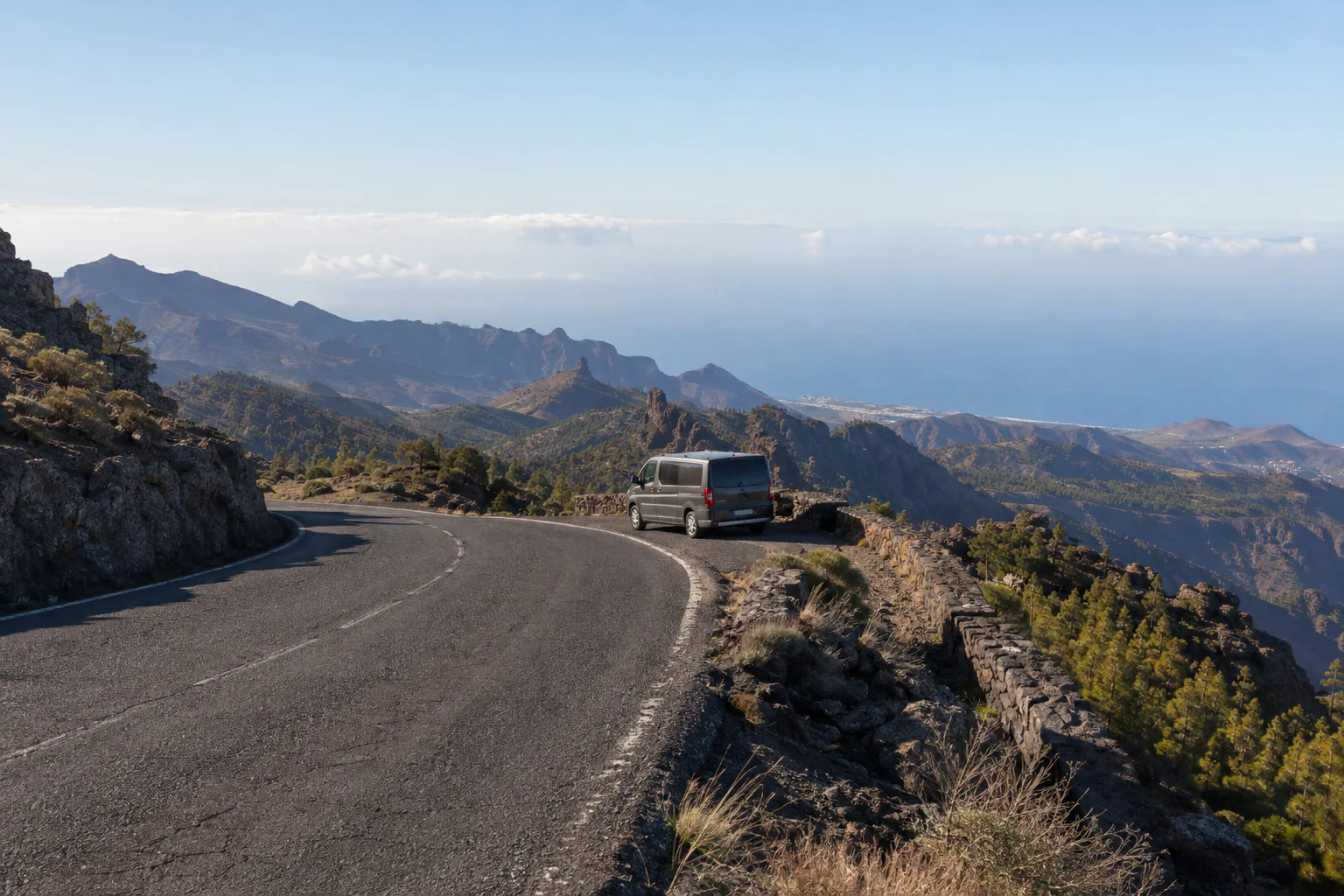
How to get around Tenerife without a car
You can travel Tenerife without a car by combining the Titsa bus network between the main towns, the tram in the metropolitan area, taxis for short hops and a guided service for the mountain areas. Public transport handles links between towns well; what it handles poorly is travel between rural districts and late-evening timetables.
Plenty of visitors assume a car is essential. It is not always, and sometimes it is not worth it: if mountain roads make someone in your group uncomfortable, three days of continuous bends can spoil a trip rather than solve it.
This piece compares the options without writing any of them off. Each solves something different.
What to understand first
The island is well connected between towns and less well connected between rural districts. The main corridors run at reasonable frequencies; reaching a mountain village on a Sunday afternoon is another matter entirely.
And there is one practical consequence that shapes everything: many landscape activities end at sunset or after dark, exactly when public transport frequencies drop. That is where most car-free plans break.
The options, one by one
The bus, or "guagua"
In the Canaries a bus is a guagua, and the island network is run by Titsa, the Cabildo de Tenerife’s public transport company. You will see both words used.
What it handles well. Links between Santa Cruz, La Laguna, the airport, Puerto de la Cruz, the southern resorts and the district capitals. It also reaches Teide National Park and places where private vehicles are restricted.
What it handles poorly. Cross-country journeys between districts, late timetables and small villages with only a few services a day.
A useful detail: there is a rechargeable travel card that makes journeys considerably cheaper than single tickets, and it works on the tram too. Check current conditions and fares at titsa.com, because they are revised.
And one case that matters especially: in some places the bus is not merely an alternative but the public way in. Access to Punta de Teno is regulated, and Titsa publishes route 369 as the visitor connection. Check the timetable and any service notices on the day.
The tram
It links Santa Cruz de Tenerife with La Laguna. It is comfortable, frequent and genuinely useful if you are based in the metropolitan area: you can sleep in one city and eat in the other without thinking about parking, which in La Laguna’s old town is a real problem.
It does not reach beyond those two cities, so treat it as a complement rather than an island-wide solution.
The taxi
Useful for short hops, for reaching somewhere the bus does not serve, and for getting back after dark. In rural areas, arrange the return in advance rather than trusting that one will be passing.
It is also what solves the last stretch when the rest of the day has gone by public transport.
The coach excursion
A large group and a fixed itinerary. The advantages are real: the cost per person is low, transport is included and you do not have to decide anything.
The limits are equally clear: fixed timings, fixed stops, pick-up time spread across many hotels, and a pace set for the group as a whole. If that suits what you want, it is a perfectly reasonable option and I am not going to say otherwise.
The private tour
It solves transport and content at the same time, with the route agreed in advance and the group’s own pace. It is the most expensive option per person and the least sensible if all you need is to get from A to B.
I devote a whole piece to when it pays off and when it does not: is a private tour in Tenerife worth it?
Quick comparison
| Option | Best for | Worst for |
|---|---|---|
| Bus | Links between towns, tight budgets, restricted-access areas | Rural districts, evening timetables |
| Tram | Moving between Santa Cruz and La Laguna | Anything outside the metropolitan area |
| Taxi | Short stretches and returns | Full days, on cost |
| Coach excursion | Seeing a lot cheaply with nothing to organise | Your own pace and flexibility |
| Private tour | One specific day with content and logistics solved | Simple transport |
Combining them on a short trip
The formula that works best, in my experience:
- Public transport for the cities. La Laguna, Santa Cruz, Puerto de la Cruz and the main links.
- A guided service or excursion for the mountains. Teide, Anaga, Teno and the north-west, where driving costs you most and public transport reaches least.
- Taxis for the gaps, particularly on the way back.
That avoids the worst outcome: renting a car for three days and genuinely using it on one.
With children, reduced mobility or luggage
- With small children, public transport between towns works well; what tires them is the changes and the waiting.
- With reduced mobility, check the accessibility of the specific route and stops, which is not uniform.
- From the airport, there are bus connections to the main areas, but with luggage and at a late hour a taxi usually pays for itself.
Before organising the day
Check routes, timetables and current fares at titsa.com, and check the access restrictions in force in natural areas at tenerifeon.es. Both change, and in the case of restricted access the difference between getting in and not getting in can depend on it.
How I can help
I am not an alternative to public transport. I am something else. When someone books a day with me, what it solves is not only the travelling but the judgement about what to do with the available hours, and the explanation of what you are looking at.
I build the route around where you are staying and the hours you genuinely have, including the pick-up, which is agreed before booking. I am an official tourist guide of the Canary Islands (GTI-289), Starlight Guide no. 40 and a qualified low and mid-mountain trail guide (AFDA0611).
Where it pays off most is on mountain days and night-sky outings, which is exactly where public transport reaches least.
→ See the private tours · Private shore excursion, if you arrive by ship with limited hours.
Frequently asked questions
Can you reach Teide by public transport? Yes, there are services up to the National Park. What needs looking at carefully are the frequencies and, above all, the last return of the day, which entirely determines whether staying for sunset is possible.
Is the travel card worth it? If you are making several journeys, almost always. Check current conditions at titsa.com, since fares and discounts are revised.
Can I visit Anaga without a car? Partly. There are services into the massif, but with limited frequencies and without covering every hamlet. For a walk on your own schedule, public transport constrains a fair amount.
And Masca? The village is reached by road. For the gorge trail, private vehicle access is not permitted and the compulsory shuttle must be used: I explain it in the Masca gorge piece.
Is driving in Tenerife difficult? Not difficult, but demanding in the mountains: continuous bends, narrow roads and scarce parking at popular spots. If it worries anyone in your group, that is a valid reason not to rent.
How do I get back from an evening activity without a car? This is the weakest point of travelling car-free. Arrange the return in advance, whether by taxi or with a service that includes it.
What if my hotel is far from a stop? A taxi for that first or last stretch is usually the simplest fix, and it does not add as much as you might think if the rest of the day is on public transport.
Organise the day with judgement
Tell me where you are staying and what you would like to do, and I will tell you what works well car-free and what does not.
→ Check availability · Tenerife in 3 days · Planning your trip
Qualifications, registrations and professional associations
Official Canary Islands Tourist Guide, Starlight Guide and low and medium mountain route guide.
- Official guideGTI-289
- Starlight Guideno. 40
- Low and medium mountainAFDA0611
- Active tourismTA-4-0026356.16
- Tourism intermediaryI-0005095.1
Registered active tourism activity with the current civil liability and assistance or accident insurance required by law.