Where and when to go stargazing in Tenerife
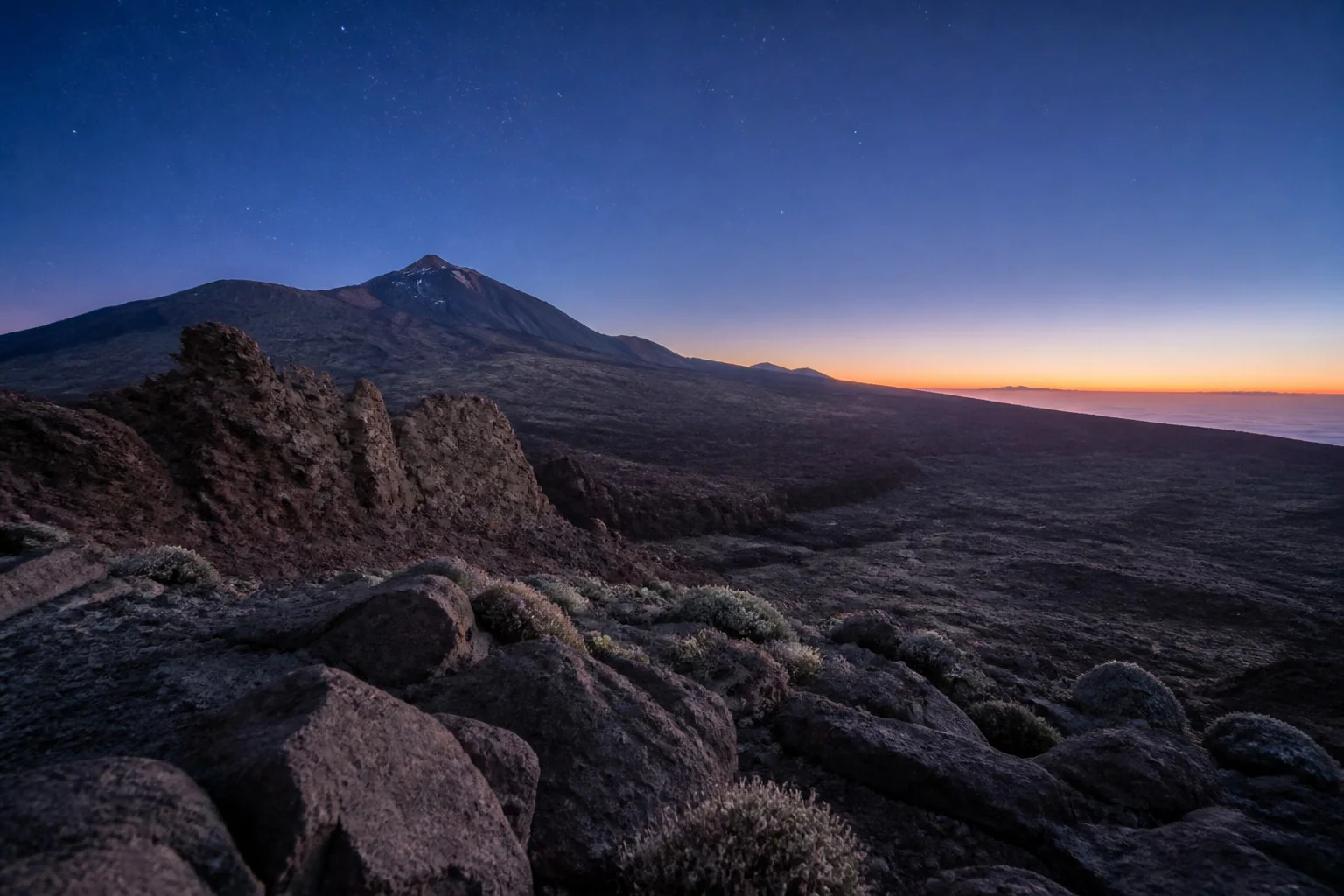
To see the sky well in Tenerife you want to be above the cloud layer, away from coastal lights, on a night without a full Moon. The high centre of the island, around Teide National Park, combines altitude, dry air and an open horizon. The month matters far less than the lunar phase and the conditions on that particular night.
I work at night for much of the year, and there is one question that comes before all the others: "where do we go?". The honest answer is that there is no single spot, and that anyone giving you a fixed one is probably not looking at the forecast.
I am Starlight Guide no. 40 and an official tourist guide of the Canary Islands. This piece sets out the criteria I use to plan each session. It is not a list of viewpoints; it is how a night and a place get chosen.
Why the sky here is different
Three factors combine, and none of them is coincidence.
Altitude. Above 2,000 metres you leave behind much of the moisture and particulate matter. There is less atmosphere overhead and the image steadies.
The cloud layer. The trade winds arrive from the north-east carrying moisture, meet the mountains and form a band of cloud on the northern slope at mid-altitude. From above, that layer acts as a lid: it holds the moisture down and, incidentally, blocks a good deal of the light from the coast. It is the same phenomenon that produces the sea of clouds, recognised by UNESCO as part of the landscape value of Teide National Park.
Legal protection. Since 1988 the Canary Islands have had specific legislation protecting the astronomical quality of the sky above the observatories of the Instituto de Astrofísica de Canarias, covering lighting, emissions and flight paths. One of those observatories sits at Izaña, on this island. Professional astronomy did not choose this place by accident.
How I choose the place
I do not work from the same spot every night, and that is the part that surprises people most. These are the criteria, in order of weight.
1. Being above the cloud layer. The decisive factor. A night that looks hopeless from the coast can be excellent up top, and the reverse is equally true.
2. A clear horizon in the direction that matters. Chasing a planet low over the horizon is not the same as looking for the Milky Way overhead. The shape of a caldera conditions a great deal of what you can see.
3. No direct light sources. More than general light pollution, what ruins a session is a single streetlamp, a lit car park or the headlights of arriving cars. A slightly worse spot with no direct light wins almost every time.
4. Wind. At altitude, wind matters more than temperature. In strong gusts a telescope vibrates and the session is spoiled, quite apart from how unpleasant it is to stand there.
5. Logistics. Real distance from where we set out, the state of the access road and safety while standing around at night. A magnificent spot you reach exhausted is not a good spot.
That is why, when someone asks me about a specific location, I answer with the area and confirm the point once I have seen the forecast for that date.
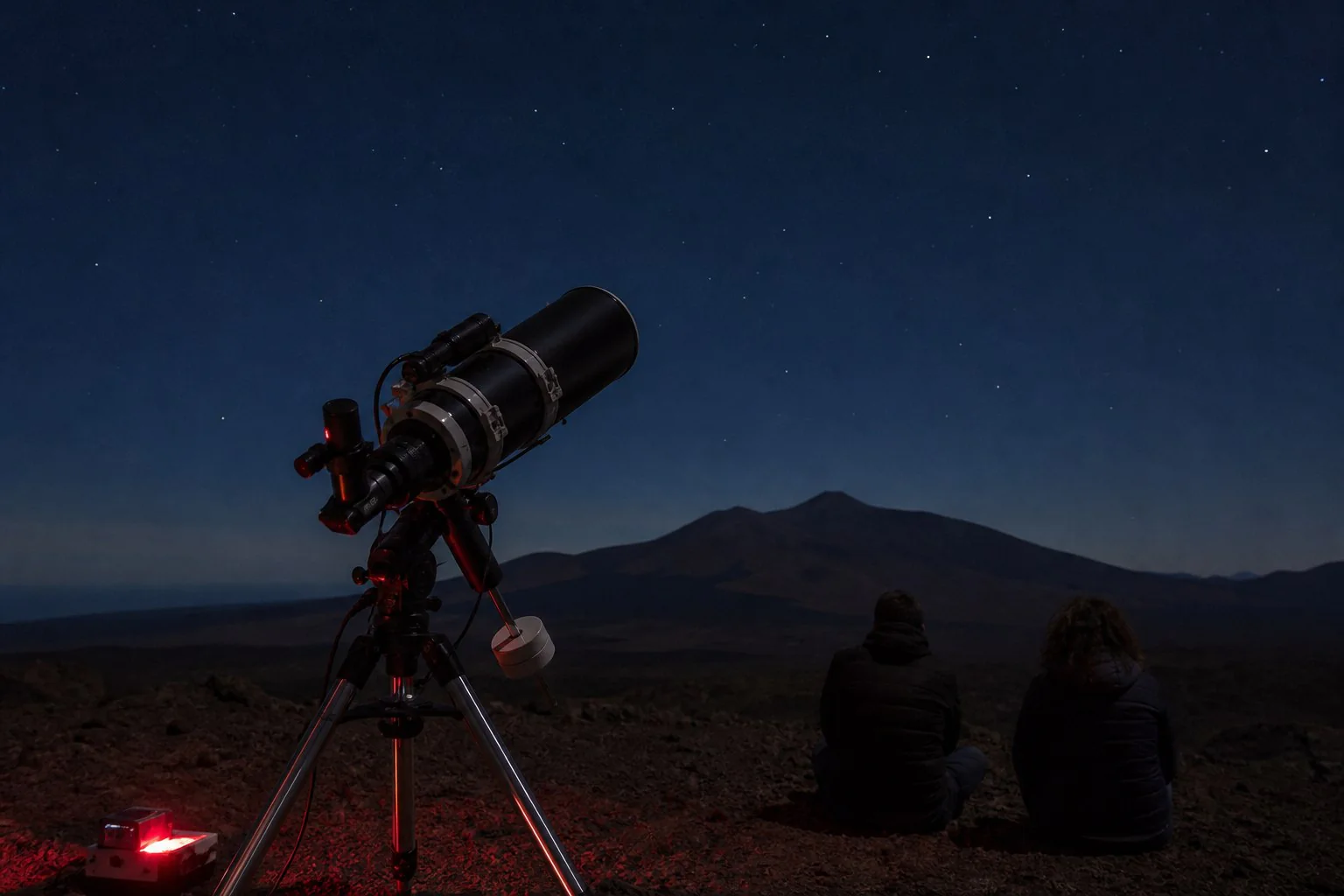
How I choose the night
The Moon rules
If you can choose your date, this decision has more impact than any other.
- Full Moon. The sky brightens and faint stars, the Milky Way and much of the deep sky disappear. In exchange, the Moon itself through a telescope is remarkable, and the night landscape is lit.
- New Moon or quarter. Far more sky available: clusters, nebulae, galaxies and the Milky Way in season.
Neither is a bad option. They are different experiences. If you are coming for the Milky Way, avoid the full Moon; if you are travelling with small children who are captivated by craters, the Moon is unbeatable.
The time of year
The sky turns through the year and what is visible changes with it:
| Season | What defines the sky | The trade-off |
|---|---|---|
| Winter | Orion and the most recognisable northern constellations; long, often very transparent nights | By far the coldest |
| Spring | Good for galaxies, which cluster in this part of the sky | Can be less stable |
| Summer | The Milky Way at its densest, with the galactic centre riding high | Short nights and a very busy island |
| Autumn | Usually good stability and fewer visitors | Nothing significant |
On top of that come the planets, which depend on the year rather than the season, and the meteor showers, with fixed dates but variable results depending on the Moon.
The weather on the night
There is no way around this one: nobody can guarantee a clear sky. What you can do is read the forecast properly. Before a session I look at high cloud, wind at altitude, calima — suspended dust that badly reduces transparency — and humidity.
Be sceptical of anyone promising guaranteed observing.
The cold is real
This is the factor most people underestimate. At night, at that altitude, it is cold even in July, and you are standing still.
- Layers, long trousers and a windproof jacket.
- Hat and gloves from October to May, without hesitation.
- Closed shoes: you will be standing on uneven ground.
- A red torch if you have one. White light destroys the whole group’s dark adaptation for several minutes.
- Your phone in night mode, brightness at minimum, no flash.
One detail that surprises people: the eye takes twenty to thirty minutes to adapt fully to darkness. That is why a good night of observing does not begin at the telescope.
What to expect, realistically
If it is your first time, adjust your expectations in two directions.
Downwards: an amateur telescope does not show the saturated colour images you see in photographs, which are long-exposure composites. What you see is subtler and mostly grey, with a few exceptions that impress immediately.
Upwards: recognising a constellation unaided for the first time, or understanding why that star sits exactly there, is what people remember months later.
And one thing I will not do: promise you specific objects. What is visible depends on the date, the hour, the Moon and the conditions. What I can promise is that the session is planned to make the most of whatever that night offers.
How I can help
Being a Starlight Guide means the sky part is prepared: choosing the time and place according to conditions, pitching the explanation to the group, and observing through an already-aligned Celestron NexStar Evolution 8 telescope. It is not an instrument you glance through for thirty seconds; it is a session with a thread running through it.
I guide three different routes in this territory, and they are not interchangeable:
- Estrellas Express, three hours, sky only. For anyone with one free evening inside a full trip.
- Sunset & Stars, four hours. Adds the volcanic landscape in afternoon light and the transition into night.
- Teide Completo, six hours. Adds an agreed walk before sunset and the observing session.
If you are torn between the three, write to me with your dates and I will tell you which fits. I do not always recommend the longest one.
Frequently asked questions
Do I have to go up to Teide to see the stars properly? It helps a great deal, because altitude leaves the moisture and the cloud layer below you. But any high point away from direct lights, with an open horizon, is an enormous improvement on the coast.
Which month is best for the sky? There is no bad month. What changes is what you see: winter for the most recognisable constellations, summer for the dense Milky Way, spring for galaxies. The lunar phase weighs more than the month.
Can I do it on my own? Yes. Drive somewhere high and unlit, let your eyes adapt and use a sky app in night mode. With binoculars — the most underrated instrument there is — you already see a great deal. Bear in mind that driving mountain roads at night is more tiring than it sounds.
Can I visit the Teide Observatory? It has its own visiting arrangements, run by the Instituto de Astrofísica de Canarias. It is a different activity from a night of observing and should be checked through their official channels.
What if there is cloud or calima that night? I check the forecast before we set out. If conditions do not allow a session that makes sense, I say so and we discuss the alternatives before deciding. I would rather have an awkward conversation the day before than a disappointing drive up.
Can I take photographs? Of the night landscape, yes, with a tripod. Astrophotography through the telescope is a separate discipline with its own equipment and its own pace, and it is not part of these sessions.
What is the difference between a Starlight Guide and a monitor? They are two distinct levels of the Starlight Foundation’s training, with different course loads. I hold the Starlight Guide qualification, no. 40, which is the higher level.
Before you pick the night
Check the forecast with AEMET and the lunar phase for your dates. If you have flexibility, write to me with the range of days you will be on the island and I will tell you which night would work best.
→ Check availability · Stargazing in Tenerife · How to visit Teide
Qualifications, registrations and professional associations
Official Canary Islands Tourist Guide, Starlight Guide and low and medium mountain route guide.
- Official guideGTI-289
- Starlight Guideno. 40
- Low and medium mountainAFDA0611
- Active tourismTA-4-0026356.16
- Tourism intermediaryI-0005095.1
Registered active tourism activity with the current civil liability and assistance or accident insurance required by law.