
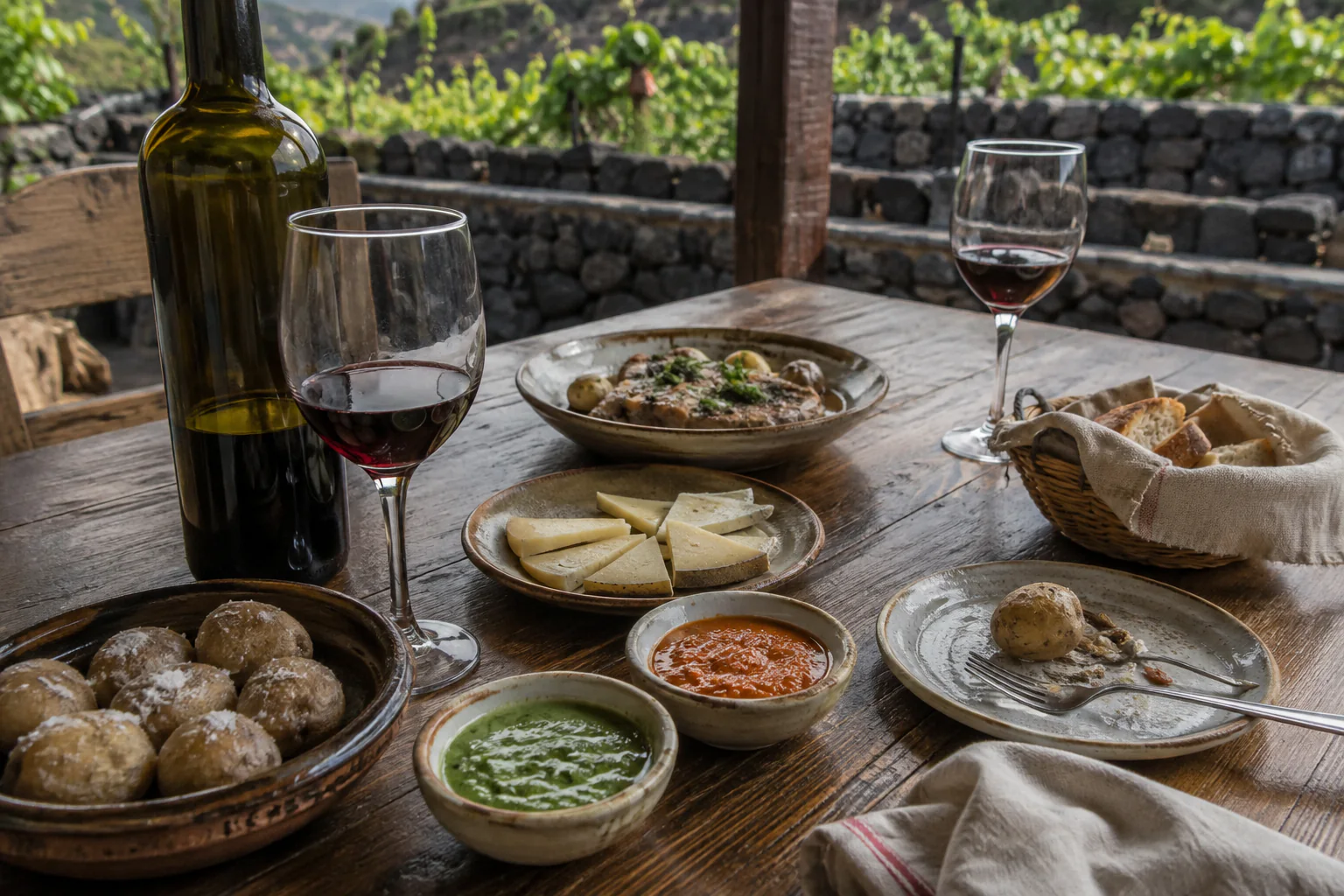
What is a guachinche, and how is it different from a restaurant?
A guachinche is an establishment particular to northern Tenerife where wine from the owner’s own harvest is served alongside a short menu of home cooking. It is not a decorating style or a category of restaurant: it is a regulated form of business, born out of the wine trade, with conditions covering the wine served and the number of dishes. Many open only while that wine lasts.
The first time I took a group to a guachinche, someone asked for the wine list. There is no wine list: there is the house wine. That answer, which can sound like a limitation, is precisely what defines the place.
This piece explains where the institution comes from, how to recognise an honest one, and what to expect when you sit down. It contains no list of "the best ones": I am not going to write one, and I explain why at the end.
Where it comes from
The origin is economic, not gastronomic. Wine growers in northern Tenerife needed to sell the wine from their own harvest, and opened up the house to sell it directly. To accompany it they served simple food — whatever was cooked in that kitchen.
Everything else follows from that: the short menu, the single wine, the location in vine country and the seasonality. A guachinche is not a restaurant that decided to look rustic; it is a family winery that put tables out.
That history connects to something larger. Long before bananas and much longer before tourism, what linked Tenerife to the world was wine. The island today has the largest vineyard area in the Canaries and five denominations of origin, each tied to a different slope and altitude. I go into that in Tenerife food and wine.
The regulated framework
This is the part almost nobody explains, and the one that helps most in knowing what you will find.
The guachinche is a defined form of business with set conditions. In practical terms, that means:
- The wine served comes from the owner’s own harvest, not bought in.
- The menu is limited in number of dishes.
- The activity is seasonal, tied to the wine cycle.
With popularity came commercial use of the name. Some places call themselves guachinches and operate as restaurants, with long menus and supplier wine. It is not culinary fraud and some of them serve very good food, but it is worth knowing what you are walking into.
How to recognise an honest one
There is no badge on the door, but there are reliable signals:
The menu is very short. Often recited aloud or chalked on a board. If there is a laminated menu with forty dishes, it is probably not a traditional guachinche.
The wine is the house wine. Ordered by measure, not by labelled bottle. Asking about the vintage is a good conversation, not an impertinence.
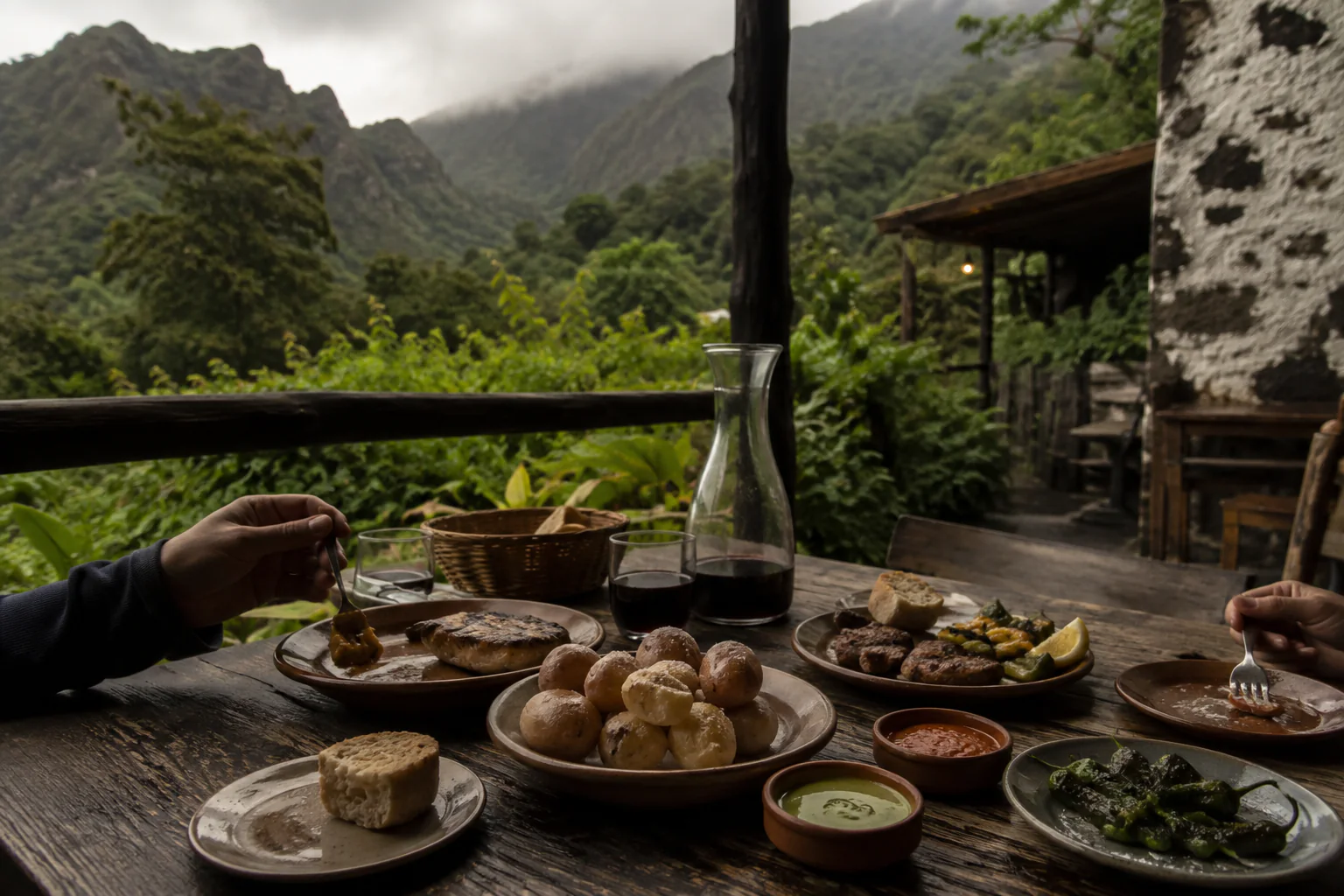
The location makes agricultural sense. They sit in vine country, almost always in the north, and often at the end of a narrow road. A guachinche on a tourist seafront promenade is, at the very least, suspicious.
Opening hours are limited and do not always match a restaurant’s.
There is seasonality. They close when the wine runs out, and they do not always announce it.
No single signal is conclusive on its own. Together they give a fairly clear picture.
The season: the most practical fact here
Many traditional guachinches open in the months after the harvest and close when the wine from that vintage is gone. Which means a particular one may well be shut in exactly the week you are on the island.
Always check it is open before setting out. That is the single most useful line in this piece. An authentic guachinche rarely has an up-to-date website, and many have none at all: you confirm by telephone.
This is also why, on my routes, the food stop is specified in the written proposal rather than announced by name in advance: which establishment works depends on the date.
What to expect on the menu
Without turning it into a catalogue, these are the dishes that give a guachinche table its shape:
- Papas arrugadas with mojo, red or green. The signature dish and the best introduction.
- Carne fiesta, marinated and fried pork, very common.
- Ribs with corn and potatoes, substantial and made for sharing.
- Rabbit in salmorejo, marinated with garlic, pepper and wine. Probably the most representative dish of all.
- Chickpea or vegetable stews, depending on the day.
- Canarian cheese, mostly goat’s milk: fresh, semi-cured or smoked.
- Gofio escaldado, toasted grain flour worked with broth. It is the pre-Hispanic inheritance of the Canarian table and the ingredient that most puzzles visitors.
Portions are generous and designed for sharing. Over-ordering is the most common mistake.
Bookings, payment and practicalities
Bookings. Some take telephone reservations, others work on a first-come basis. At weekends and on public holidays it is worth calling.
Payment. Not all of them take cards. Bring cash: it is the most frequent practical problem.
Diets and allergies. Guachinche cooking is very meat-heavy and the menu is short by definition, so there is limited room to adapt. If there is an allergy or a strict restriction, ask by phone before going. Potatoes, stews, cheese and local vegetables give you something to work with, but do not assume an alternative will be waiting.
Hours. People eat late here, and many northern places close early in the evening.
Behaviour. Many guachinches are family houses with tables. Volume, manners and respect for the space matter more than in a conventional restaurant. And parking is usually a narrow road: leaving the car without blocking access is part of the visit.
Why I do not publish a list of the best ones
Three reasons.
First, they open and close by season, so any list ages badly and can send someone driving forty minutes to a closed door.
Second, they do not all work the same way. The same place can be excellent on a Tuesday in February and unremarkable on a Saturday in August.
Third, a public list changes the place. The guachinches that work best do so at a certain scale, and appearing in a ranking does not always do them a favour.
I would rather explain how to recognise one and let each traveller find their own.
How I can help
On one of my private days, the guachinche stop closes an itinerary that begins in the historic centre of San Cristóbal de La Laguna and continues with a walk through the Anaga forest. The logic is that the table should come after the territory: food makes more sense once you have seen where it comes from.
The specific arrangement for that stop, including how it is paid, is set out in the written proposal before booking, and the establishment is chosen according to the date and what is actually open.
→ See La Laguna, Anaga and a guachinche, the six-hour private day.
If wine in more depth is what interests you, the other route in that section drops into the northern vineyard landscape: La Laguna and Bodegas Monje.
Frequently asked questions
What does the word "guachinche" mean? Its origin is disputed and several popular explanations circulate about where it comes from. What is clear is what it refers to today: the northern Tenerife establishment where own-harvest wine is sold with home cooking.
Is it the same as a winery? No. A winery makes wine and may run visits and tastings, usually by prior booking. A guachinche is a place where you eat and drink that production, with no technical tour.
Can I book a table? It depends on the place. Some take telephone bookings and others work on arrival order. At weekends it is worth calling ahead.
Do they take cards? Not all of them. Carrying cash avoids the most common problem.
Are there vegetarian options? Few, and not guaranteed. The menu is short and very meat-heavy. Ask by phone beforehand if it is essential.
Is it a good place to go with children? It usually works well: informal, long tables, sharing plates. What needs planning is the timing and the access road.
Can I drive there if I am going to drink wine? This is the point worth thinking about beforehand. Guachinches sit on narrow northern mountain roads. If you are going to drink, organise the way back.
How is a guachinche different from a tasca? A tasca is a bar serving food, it can be anywhere, and it pours supplier wine. A guachinche is tied to its own harvest and to an agricultural cycle.
Before you go
Call and confirm it is open. If you are travelling outside the main season, that call will save you a drive.
And if you would rather the stop formed part of a day with context behind it, write to me with your dates.
→ Check availability · Tenerife food and wine · What to see in La Laguna
Qualifications, registrations and professional associations
Official Canary Islands Tourist Guide, Starlight Guide and low and medium mountain route guide.
- Official guideGTI-289
- Starlight Guideno. 40
- Low and medium mountainAFDA0611
- Active tourismTA-4-0026356.16
- Tourism intermediaryI-0005095.1
Registered active tourism activity with the current civil liability and assistance or accident insurance required by law.